01 — Research question
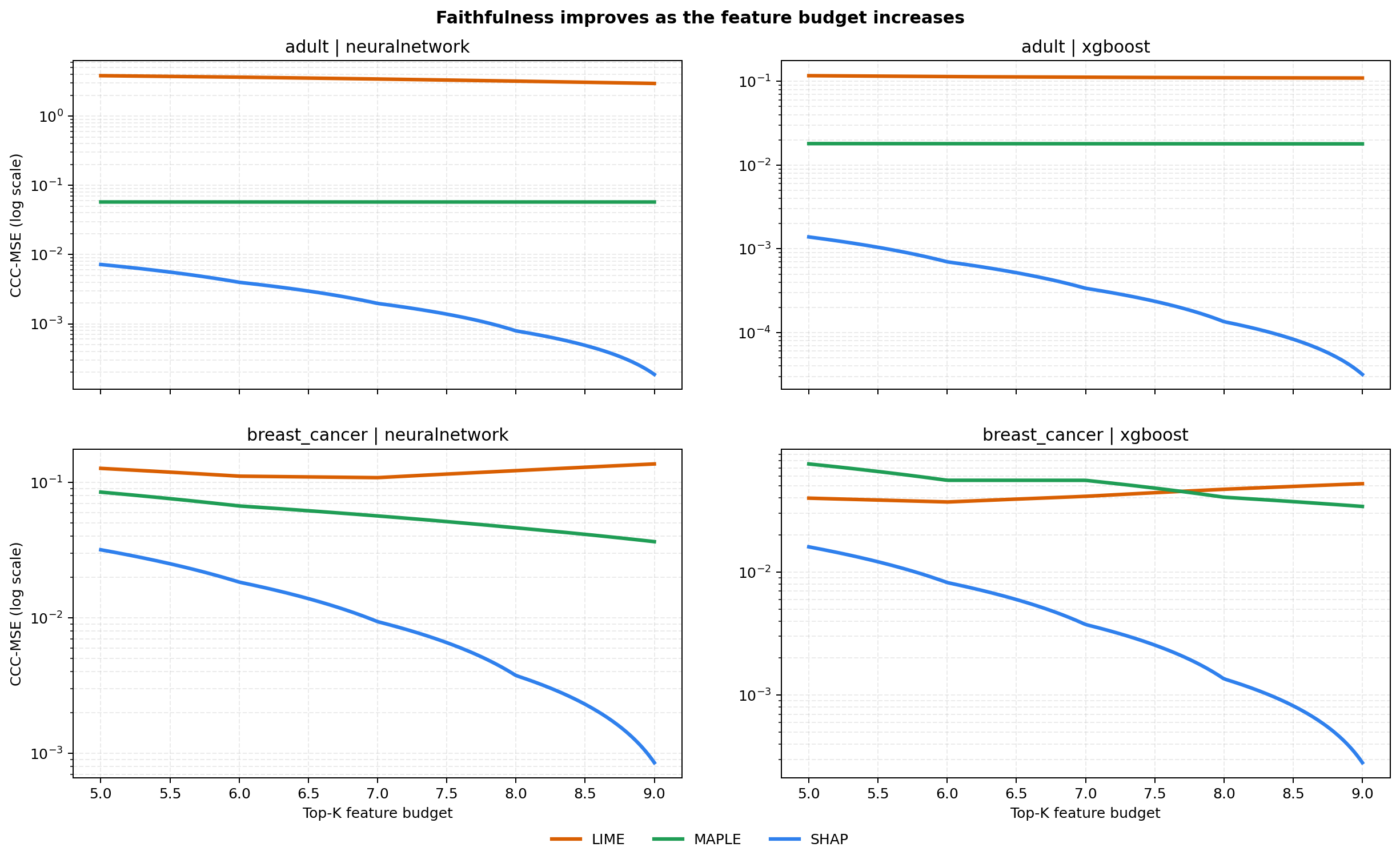
Local explainers can produce a complete list of feature contributions, but people rarely inspect every feature. EQE asks whether an explanation still reconstructs the black-box prediction when only its top K contributions remain.
The project turns a cognitive constraint into an evaluation protocol: compact explanations should preserve model behavior better than arbitrary feature subsets.
02 — CCC metric
Complexity-Calibrated Local Concordance measures the mean squared error between the black-box probability f(x) and an additive reconstruction gK(x) built from only the top K explanation contributions:
Lower values indicate that the compact explanation remains faithful. Evaluating a range from K = 5 to K = 9 makes the fidelity-versus-complexity trade-off explicit instead of hiding it inside a full explanation.
03 — Benchmark design
The benchmark evaluates LIME, SHAP and MAPLE on the Adult and Breast Cancer datasets. Each explainer is paired with XGBoost and a neural network, then repeated across seeds 42, 123 and 2026.
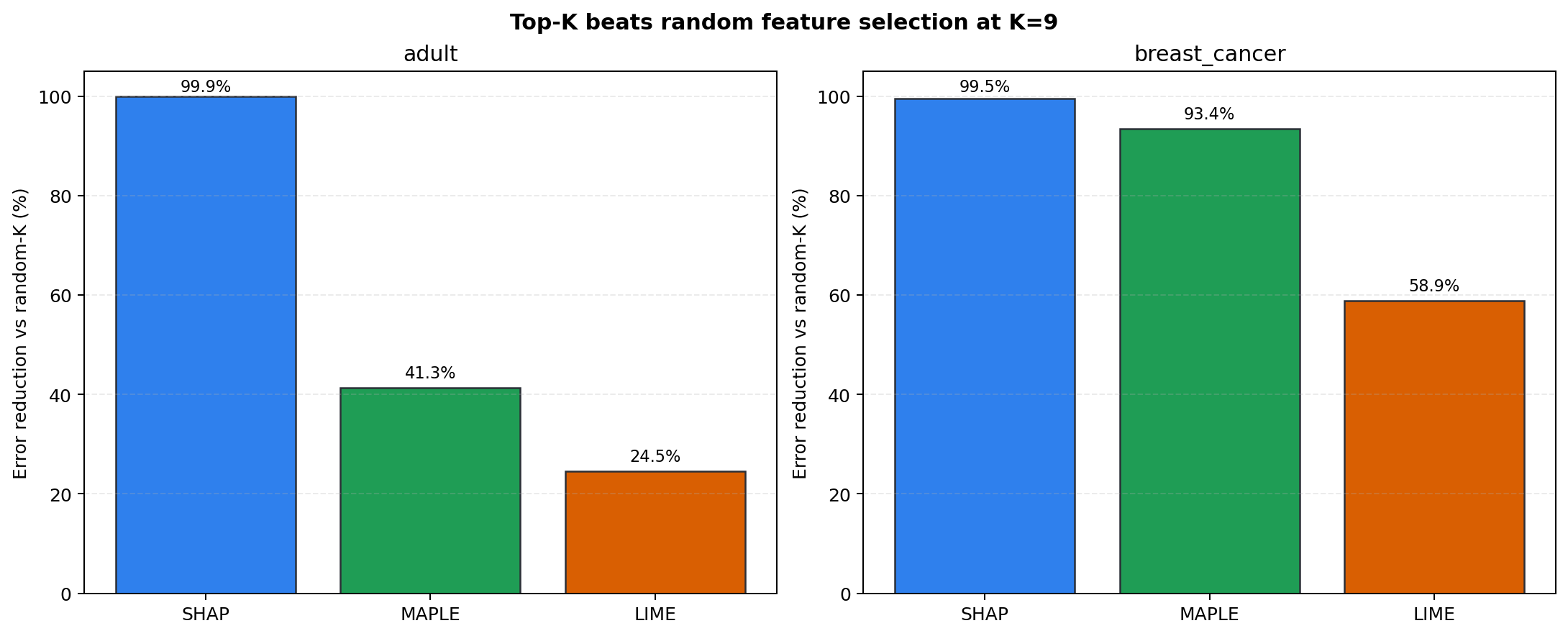
Alongside CCC, the pipeline records full-reconstruction error, sufficiency, comprehensiveness, normalized CCC and a random-K control. The control is essential: it tests whether an explainer’s feature ranking adds value beyond selecting the same number of arbitrary features.
04 — My contribution
I implemented benchmark orchestration, normalized the different additive-contribution formats, developed the CCC evaluation path and produced the comparative visual analysis. The pipeline writes both machine-readable results and publication-ready figures for each run.
05 — Results
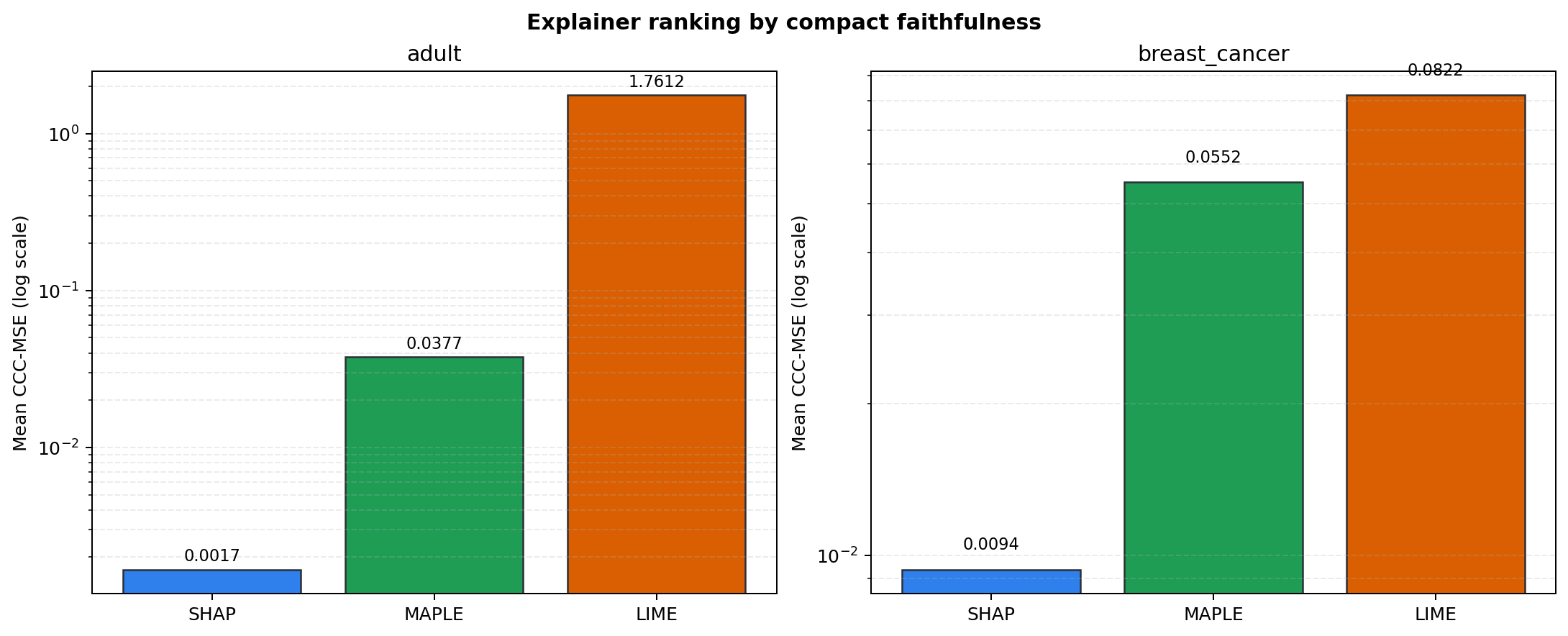
SHAP produced the strongest compact faithfulness across the evaluated settings. MAPLE was generally intermediate, while LIME was the least reliable—especially for the neural-network experiments.
At K = 9, top-ranked SHAP features reduced reconstruction error relative to random selection by 99.9% on Adult and 99.5% on Breast Cancer in the aggregate comparison. The result validates the central premise: explanation ranking quality matters under a fixed attention budget.
06 — Limitations and takeaway
CCC evaluates local additive reconstruction, not every desirable property of an explanation. A low error does not by itself guarantee causal validity, stability or usefulness to a particular person.
Its value is narrower and practical: it makes compact faithfulness measurable, comparable and reproducible. EQE complements broader XAI metrics with the question users actually face—what survives when they can inspect only a few features?